A widening parting, more scalp visible under bright light, or a hairline that no longer frames your face in the same way can affect confidence more than people expect. When comparing PRP versus hair transplant, the central question is not which treatment is “best” overall. It is which approach suits your pattern of thinning, the condition of your existing hair, your appetite for downtime and the result you hope to achieve.
PRP is a non-surgical treatment designed to support existing follicles. A hair transplant is a surgical procedure that redistributes hairs from a donor area to thinner areas. Both can have a place in a long-term hair-restoration plan, but they work in very different ways.
PRP versus hair transplant: the fundamental difference
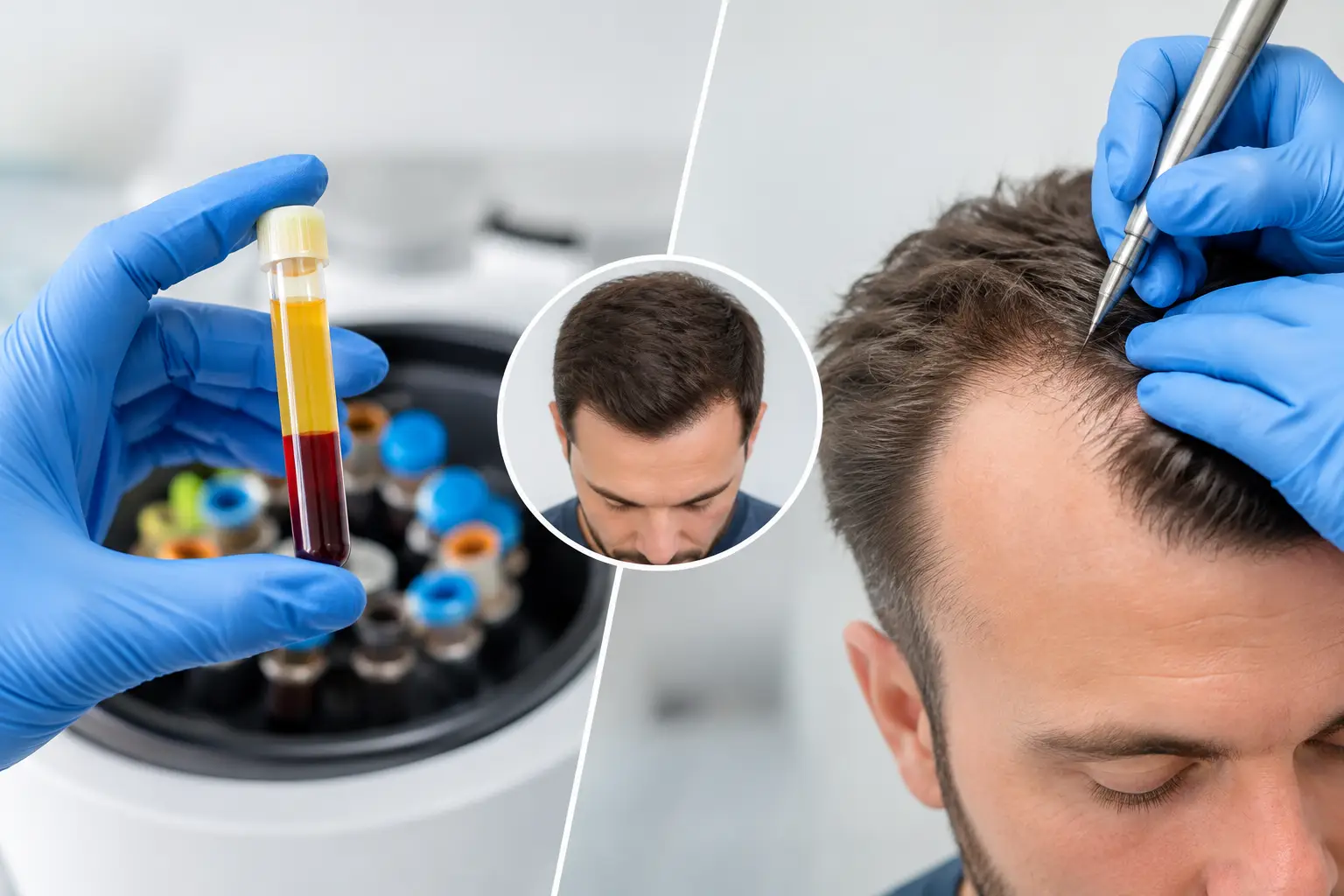
Platelet-rich plasma, usually known as PRP, uses a small sample of your own blood. It is processed to concentrate platelets, then carefully injected into areas of the scalp where hair appears thinner. Platelets contain growth factors that may help support the environment around existing hair follicles and encourage healthier-looking, stronger growth over time.
PRP does not create new follicles. Its role is to work with follicles that are still present, particularly where hair has become finer, less dense or slower growing. For this reason, it is often considered by people at an earlier stage of visible thinning, or by those who want a non-surgical option before considering surgery.
A hair transplant takes follicles from a donor area, commonly at the back or sides of the scalp, and places them into areas with reduced density. Because follicles are physically moved, transplant surgery can create coverage in areas where there are few active follicles left. It is a more significant commitment, with a surgical recovery period and careful aftercare.
Neither treatment is an instant fix. PRP usually requires an initial course of sessions and ongoing review. Transplanted hair also takes time to settle, shed and regrow, with the final appearance developing gradually over many months.
When PRP may be the right starting point
PRP hair restoration can be appealing when you want to take a proactive, non-surgical approach to thinning. It involves no incisions, no removal of follicles and typically little disruption to day-to-day life. The scalp may feel tender or look mildly red after treatment, but this is usually temporary.
It can be particularly appropriate when the concern is diffuse thinning rather than a completely bare area. For example, you may notice a broader parting, reduced density through the crown, or hair that feels less substantial than it once did. The aim is not to change your hairline dramatically overnight. It is to support hair quality and density where follicles remain capable of producing hair.
PRP also suits clients who value subtle, progressive change. Results vary, but people may notice reduced shedding, stronger-feeling hair and an improvement in the appearance of fullness as treatment progresses. Photography taken under consistent lighting can be helpful, because hair changes can be gradual and easy to miss in the mirror.
At Mr Aesthetics, a consultation allows your practitioner to assess the areas that concern you, discuss realistic outcomes and create a treatment plan that fits your goals. A series is commonly advised because hair growth follows a cycle, not a single-event timeline.
The advantages of PRP
The main benefit is that PRP is non-surgical and uses your own platelet-rich plasma. There is no donor-site scar and little downtime, making it a practical choice for clients with busy work, family or social schedules.
It can also form part of a maintenance-focused approach. Hair thinning may continue to change over time, so supporting existing hair early can be valuable even if you later decide that surgery is right for you. PRP is not guaranteed to work for every person, and a responsible consultation should be clear about that from the beginning.
Its limitations
PRP cannot replace follicles that are no longer active. If an area has been bare and smooth for a long time, injections are unlikely to produce the density that a transplant may achieve. It is also not a one-off treatment. Maintaining the appearance of supported hair may require follow-up sessions at intervals recommended for you.
The degree of improvement depends on factors including your starting point, the extent of thinning and how your follicles respond. Think of PRP as a regenerative support treatment rather than a way to manufacture a brand-new hairline.
When a hair transplant may be more suitable
A hair transplant may be considered when there is established hair loss in a defined area, such as a receding hairline, sparse temples or a crown with limited remaining density. It can offer a more visible change in coverage because follicles are transferred directly to the area of concern.
However, candidacy is not simply about wanting more hair. A surgical provider needs to consider whether the donor area has sufficient density, how hair loss may progress and whether the proposed design will still look natural in the years ahead. A conservative, well-planned hairline often matters more than chasing maximum density in one session.
Surgery also requires patience. The recipient area and donor area need time to heal, and transplanted hairs commonly shed before new growth begins. This is an expected part of the process, but it can feel discouraging if you are not prepared for the timeline. Visible regrowth develops gradually rather than immediately after the procedure.
The trade-offs of transplant surgery
The potential for significant, long-lasting coverage is the key attraction of a transplant. It may be the more effective route for areas where PRP alone cannot provide enough improvement.
The trade-off is that it is surgery. There will be recovery considerations, aftercare requirements and the possibility of scarring, as well as a higher financial commitment than a course of PRP. It also does not stop non-transplanted hair from continuing to thin, which is why long-term planning is essential.
For some people, the strongest strategy is not PRP or transplant in isolation. PRP may be used to support existing, non-transplanted hair while a transplant addresses areas with more advanced loss. Whether that is appropriate depends on an individual assessment and should never be assumed.
How to make the decision with confidence
Start by being specific about what is bothering you. Is your concern overall volume, a widening parting, a receding hairline, a sparse crown or a combination of these? The answer changes the conversation. PRP may be well suited to improving the look of general thinning, while transplant surgery may better address a clearly defined area with very limited growth.
Next, consider your tolerance for downtime and maintenance. PRP is usually easier to fit around everyday life, but it requires a course and periodic maintenance. A transplant has a more involved recovery but may offer a more structural change in the right candidate.
Finally, be honest about the result you want. If your goal is healthier-looking existing hair and a gradual improvement in thickness, PRP may align well. If you are hoping to restore a long-lost hairline or fill a bare patch, a transplant consultation may be the more realistic next step.
Questions worth asking at a consultation
A good hair-restoration consultation should feel clear, not pressured. Ask what result is realistic from your current level of density, how many PRP sessions are likely to be advised and when any change could become noticeable. If you are considering transplant surgery, ask about donor-area suitability, healing, long-term planning and how future thinning could affect the result.
It is also sensible to share any relevant health information, current medicines and changes in your hair or scalp with your practitioner. If thinning has appeared suddenly or is accompanied by scalp discomfort, seeking advice from an appropriate healthcare professional before aesthetic treatment is a sensible first step.
The right choice should leave you feeling informed, not rushed. Whether you begin with PRP or decide to explore surgical restoration, a personalised plan focused on natural-looking density can help you move forward with greater confidence.